|
|





|
Tracing tempi changes in Donizetti’s
Maria Stuarda
Russell Burdekin, July 2022 The range and number of Donizetti operas being performed have increased out of all recognition over the almost 50 years of the Donizetti Society’s existence. Performers now seek to uncover the operas’ dramatic potential rather than just be content with an impressive execution of the notes. One of the operas that has benefited from this renewed interest is Donizetti’s Maria Stuarda. The following study looked at one aspect of how performances of its final cabaletta, “Ah! se un giorno da queste ritorte”, have changed since 1967. The time taken for it has increased by around a quarter. Possible causes for this were examined using ideas from evolution theory applied to musical development and performance style. The investigation also looked at some individual performances, differences between stage and concert performances, the changing view of the nature of the cabaletta, the impact of studio recording on performance and the question of who set the tempi. The troubled history of the opera is probably well known to Society members: its initial banning in Naples in 1834, a poorly performed revised score in Rome with Maria Malibran the following year (which also ended up banned) and a few scattered performances culminating in its eventual appearance in Naples in 1865. After those performances there followed almost a century of silence until its revival in Bergamo in 1958. One result of this tangled history was a number of editions of the opera. In the absence of the autograph score, initially these were based on the score used in Naples in 1865 but sometimes drew on the vocal score for the revised 1835 Rome production. The discovery of the autograph score in Sweden in the early 1980s led to the creation and publication by Anders Wiklund of a critical score of the opera in 1991. As far as the final cabaletta was concerned, the edition used was of little immediate consequence as differences between editions were very few. The cabaletta is in the usual format of a section, a response by other singers and then a repeat of the section. The method used relied on recordings, both official and, more usually, unofficial. Luckily at the time when the study was started in 2015, there were a considerable number of recordings available, mainly on youtube.com. In all 133 examples were found spanning from 1967 to 2022. The times for the first time through and for the repeat were measured using the Audacity package.
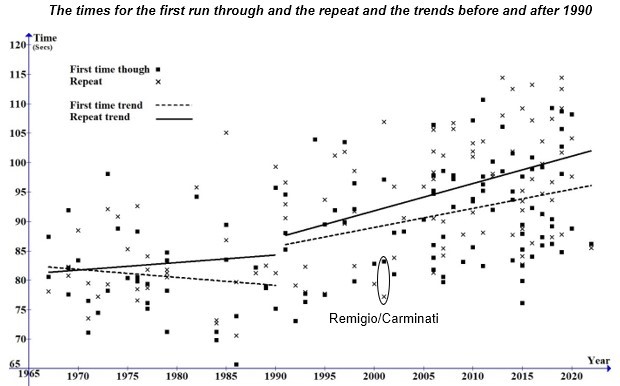
These times were plotted against year of performance, see below, and the main trends were drawn. The graph shows a broad scattering of points reflecting, as expected, a wide range of approaches. The trends for both the first time and the repeat prior to 1991 were roughly flat but after that they rose steadily. This showed that, from the 1990s, there was a switch by some performers from the traditional view of the cabaletta as a fastish number with an even faster repeat to a preference for a slower cabaletta with an even slower repeat. The latter probably felt that the slower speeds offered greater dramatic impact. Even so, adherents of the earlier approach were still very much in evidence.
The first thought on the switch was that it was a result of the publication of the critical score despite the lack of differences for the cabaletta from earlier scores. However, post 1990 performances using earlier scores often showed the same slowing behaviour while initial critical score performances often kept to pre 1990 speeds. This led to looking at José Bowen’s and David Leech-Wilkinson’s use of evolutionary theory to explain changes in performance practices. Bowen talked of the “fit” of a performance with its environment, i.e., its cultural milieu and audience responsiveness, while Leech-Wilkinson explored the process of establishing a sustainable performance style that would differentiate a performer while still being acceptable in their environment. In the earlier decades, unfamiliarity with the opera might have led performers to stay close to emerging practice, i.e., to stay within the known environment. With growing experience of the opera and with a greater presence of the opera in opera houses, performers increasingly might have wanted to differentiate themselves from past efforts. The publication of the critical score might well have accelerated this by encouraging a fresh look at the opera. The particularly fast rendering by Carmela Remigio / Fabrizio Maria Carminati at Bergamo in 2001, the first commercial recording using the critical score, was an obvious reference point and reaction to its fast tempi might have reinforced the move to slower tempi. Once the slowing trend had started and had been found acceptable by performers and audiences then an obvious differentiation for a new entrant, using past recordings as their reference, would be to go slower still thus reinforcing the slowing trend. On the stage, this would give the opportunity for a more emphatic staging that, in turn, might amplify the slowing trend. The slowing raises the question whether the cabalettas and particularly the final cabalettas of other bel canto operas might see similar behaviour. A similar, less detailed, exercise with Maria’s opening cavatina and cabaletta did not show a similar trend but no other numbers were examined. There did not seem any strong relationship between the final cabaletta times and the time taken for the complete opera. Notwithstanding complaints by performers, the data did not support the idea that directors controlled the music, at least as far as these tempi were concerned. In practice, certain singers, e.g., Edita Gruberová, but, usually, conductors seemed to be the prime movers. The inhibiting effect of studio recording on performance has been widely acknowledged. In this case, the studio recordings showed a definite impact on performances, usually, although not exclusively, slowing them even further than the main trends.
|